
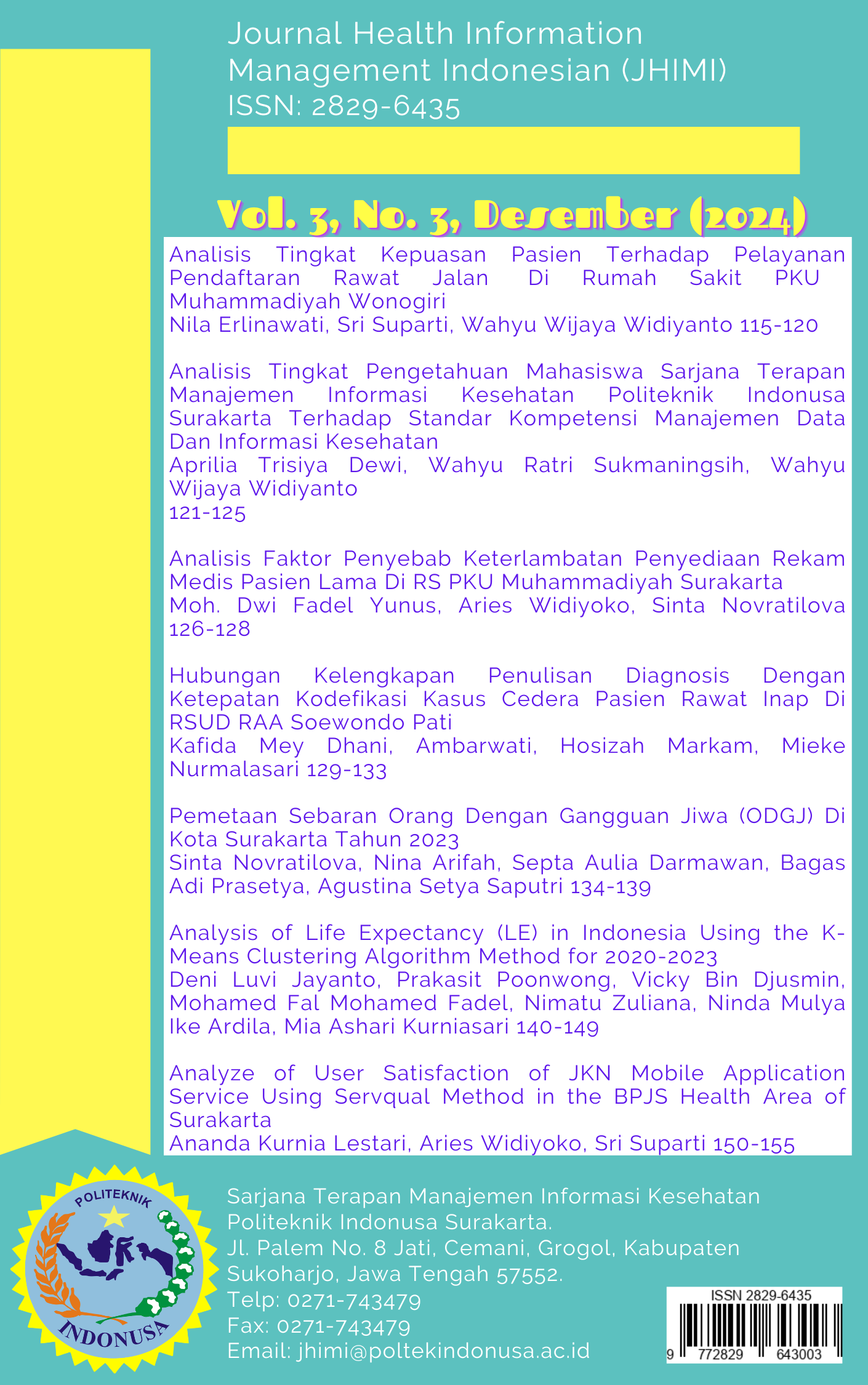
ANALISIS TINGKAT KEPUASAN PASIEN TERHADAP PELAYANAN PENDAFTARAN RAWAT JALAN DI RUMAH SAKIT PKU MUHAMMADIYAH WONOGIRI
DOI:
https://doi.org/10.46808/mik.v4i3.86Keywords:
Patient statification, service quality, outpatienAbstract
Patient satisfaction is an important part of health facilities. The level of patient satisfaction depends on the quality of service. The waiting time for patients shows < 10 minutes, there is only one registration counter and there is no division between counters for general patients and patients using BPJS cards. The purpose of this study was to analyze the level of satisfaction with outpatient registration services at PKU Muhammadiyah Wonogiri Hospital. The type of research used is quantitative research with analytic descriptive research methods with a cross sectional design. Data collection techniques using outpatient questionnaires. Univariate, bivariate and multivariate analyzes with the chi square test were used in this study. The sample of this study consisted of 100 outpatients as many as 100 people. The results of the statistical test analysis using the Chi-square test showed that there was a significant relationship (p-value <0.05) for the Responsiveness variable p = 0.015, Reliability p-value = 0.015, Assurance p- value = 0.039, empathy p = 0.003, physical evidence (tangibles) p-value = 0.000. Based on the results of multivariate analysis, it was found that the elements most strongly related to patient satisfaction with outpatient registration services were empathy, OR 7.144 (95% CI: 1.005 – 50.748) and tangibles, OR 10.487 (95% CI: 1.777). – 61,898).
Downloads
Published
How to Cite
Issue
Section
License
Copyright (c) 2025 Nila Erlinawati, Sri Suparti, Wahyu Wijaya Widiyanto

This work is licensed under a Creative Commons Attribution-ShareAlike 4.0 International License.
You are free to:
Share — copy and redistribute the material in any medium or format
Adapt — remix, transform, and build upon the material for any purpose, even commercially
Under the following terms:
Attribution — You must give appropriate credit, provide a link to the license, and indicate if changes were made. You may do so in any reasonable manner, but not in any way that suggests the licensor endorses you or your use.
ShareAlike — If you remix, transform, or build upon the material, you must distribute your contributions under the same license as the original
No additional restrictions — You may not apply legal terms or technological measures that legally restrict others from doing anything the license permits